
Ottawa County Release Dates: Planned or Final
A projected date is a calculation or decision about a future event. An actual release is the physical end of custody under that agency. The two can differ. A state record may show a date while a hold, discipline decision, parole action, or corrected sentence is still pending. A county court may issue a release order before jail staff complete processing. Conversely, leaving one facility may be a transfer and not a return to the community.
Pretrial custody is different. A person awaiting trial does not serve a fixed sentence with an end date. Bond, recognizance, dismissal, plea, sentencing, or another court order may cause release, and the timing depends on the order and jail processing. A court docket can explain the authority for release, while the Ottawa County Sheriff’s date-and-manner-of-discharge entry confirms the physical exit.
Match Ottawa County Custody First
The correct source follows the sentence. The Ottawa County Detention Facility and Minimum Security Jail are county facilities. Their dates come from the sentencing court, credited jail time, and Sheriff records. ODRC calculates state-prison dates under Ohio sentencing and earned-credit rules. Federal and immigration systems are separate again.
| Custody or case | Date source | What to request or read |
|---|---|---|
| Pretrial Ottawa detainee | Municipal or Common Pleas docket | Bond, dismissal, sentencing, or other journal entry, then Sheriff discharge record |
| Sentenced county inmate | Court and Ottawa County Sheriff | Journal entry, jail-time credit, sentence record, date and manner of discharge |
| Ohio state prisoner | ODRC Offender Search | Expected Release Date/Parole Eligibility Date, sentence fields, status, release detail |
| Federal inmate | BOP Inmate Locator | Projected or past release date and location, followed by the correct custodian |
No Ottawa-specific county good-time policy was found in the reviewed official sources. ODRC rules must not be imported into a county-jail calculation. Ask the Sheriff for the current county policy when it matters, and rely on the journal entry plus the records actually maintained for that sentence.
Find an Ottawa County Projected Release
Start with the person’s current or expected custodian. An Ottawa commitment does not mean the person remains in a county jail. State prisoners may be housed elsewhere in Ohio, and the ODRC detail follows them statewide. Use an offender number when known because it sharply reduces mistaken identity.
- Check Ottawa County JailTracker only for current local visibility. Absence does not prove release.
- Read the correct Municipal or Common Pleas docket for bond, sentence, jail-time credit, judicial release, or a later order.
- For county custody, ask the Jail Desk or Sheriff records custodian for the existing sentence and discharge records.
- For state custody, open the ODRC Offender Search and use the offender number or name with County of Commitment set to Ottawa.
- Compare identifiers, sentence fields, status, and the combined expected-release or parole-eligibility label.
- Recheck near the date, then verify actual departure through release detail or date and manner of discharge.
The full Ottawa County release-record lookup can help when the person’s path crosses jail, court, state, or federal systems. For a direct county question, the Jail Desk is 419-734-6828. Ask whether the person remains in either Ottawa facility, then request the existing record if release has already occurred.
ODRC Ottawa County Release Fields
The ODRC Offender Search has unusually useful filters. Search fields include name, offender number, County of Commitment, Residential County, ZIP, status, and Next Parole Board Hearing Date. Status options include Incarcerated, Released, APA Supervision, and Violators at Large. County of Commitment means the sentencing county, not the current home or institution.
On a matching detail, read the entire date label: Expected Release Date/Parole Eligibility Date. ODRC uses one field for two concepts. Nearby sentence and parole fields decide which applies. A parole eligibility date means the person may be considered. It is not a scheduled community release. The page may also show POA/PRD Date, meaning parole on or after or projected release date.
The official ODRC search screen displays the status and county filters used to narrow an Ottawa County result.
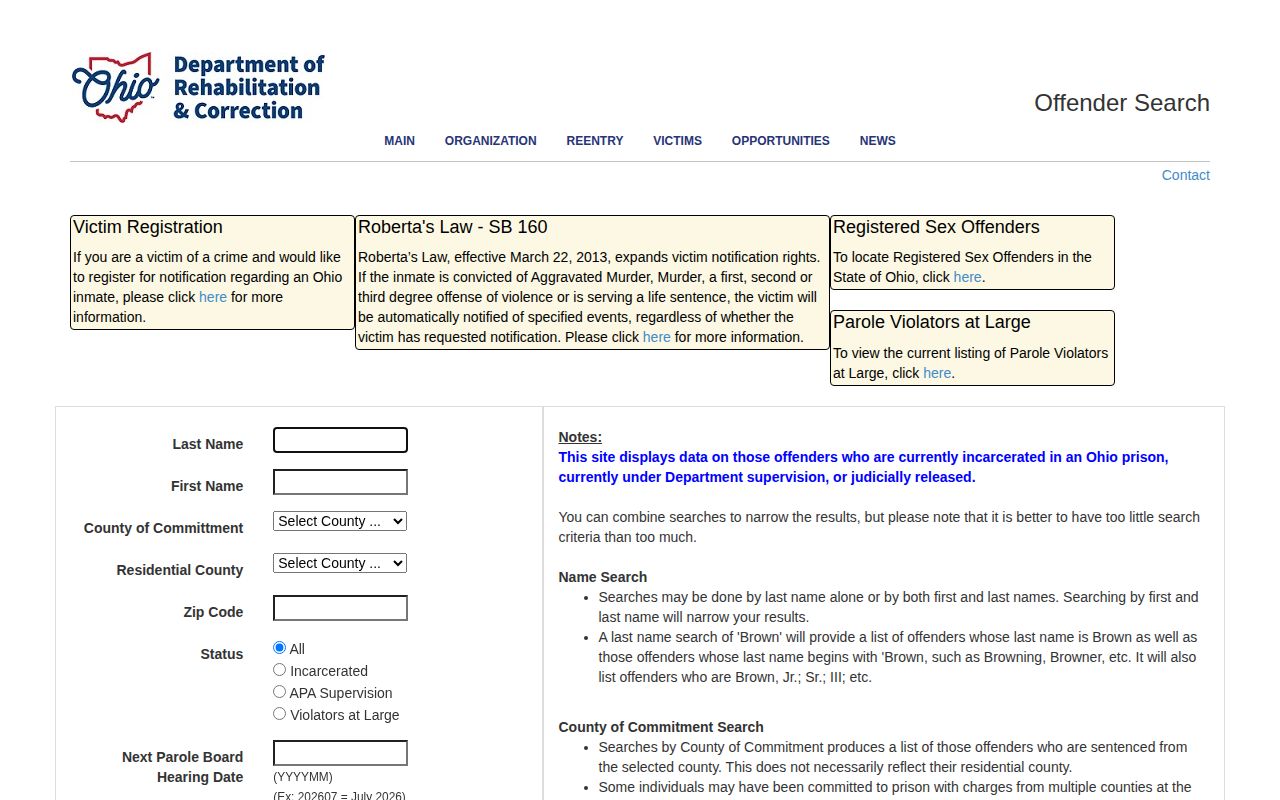
Those filters locate a candidate record. The detail page and the meaning of its combined date field still control interpretation.
Note: Residential County works for APA Supervision and Violators at Large, while County of Commitment identifies the sentencing source.
When Ottawa County Release Labels Overlap
Ohio’s combined label is a local release-date trap. “Expected Release Date/Parole Eligibility Date” might be a calculated end point or only the first chance for parole review. POA is also prospective. A favorable parole outcome can set a parole-on-or-after date, yet the Ohio Parole Board can stop release through release day.
Read the offense, sentence aggregate, hearing result, review month, and POA/PRD field together. Then check the status after the date. Released status, Parole or Release Detail, Supervision Start Date, and the named APA office can support that the event occurred. A VINE event adds notice, but neither an eligibility date nor an alert alone is a certified discharge record.
This distinction also keeps parole from being confused with probation. ODRC’s Adult Parole Authority manages state community supervision. Ottawa Municipal and Common Pleas probation are court systems. A local probation case may never display as APA Supervision.
Ohio Credit and Ottawa County Releases
Ohio Revised Code 2967.194 governs current earned credit beginning April 4, 2024. Eligible people may provisionally earn one or five days for each completed month of productive participation. A second qualifying activity can add up to five days. Credits pass through a conduct review and may be denied or withdrawn after institutional violations.
Ordinary participation and completion credit under that law is capped at 15 percent of the stated prison term. Separate listed completion awards can be 90 days or 10 percent of the stated term, whichever is less, but exclusions apply. Mandatory or nonreducible terms, life without parole, specified violent or sex offenses, and several other categories may receive no ordinary credit. Former ORC 2967.193 governs confinement before the new law’s effective date.
Ohio therefore has no universal rule that every person serves exactly 85 percent. The ordinary 15 percent ceiling creates only a rough floor for an eligible term. Jail-time credit, concurrent or consecutive sentences, conduct, special completion awards, judicial release, parole discretion, and indefinite-sentence rules can all change the result. For qualifying Reagan Tokes indefinite terms, ORC 2967.271 supplies separate presumptions and possible earned early release. Parole-eligible life or indefinite sentences follow offense-specific rules in ORC 2967.13.
These are ODRC frameworks. They do not establish Ottawa County jail credit. The county calculation should remain tied to the court entry, Sheriff corrections records, and any current county policy supplied by the responsible office. The separate indefinite-sentence statute should be read only when that sentence type applies.
Why Ottawa County Release Dates Change
A date can move in either direction. Some changes correct the underlying sentence. Others reflect conduct, a new legal order, or another agency’s authority. The displayed date should always be treated as the most recent calculation, not a promise made at admission.
| Factor | Possible effect | Where to confirm |
|---|---|---|
| Corrected jail-time credit | Moves the calculation after sentencing records are fixed | Court entry and ODRC sentence detail |
| Earned credit or program completion | May reduce an eligible ODRC term | ODRC record and governing statute |
| Discipline or credit withdrawal | Can remove provisional credit | ODRC calculation |
| Parole grant, denial, or continuance | Creates, moves, or withholds a POA or later hearing | Parole result and ODRC detail |
| New sentence, detainer, or hold | Can continue custody under this or another agency | Court and receiving custodian |
| Judicial release or new court order | May cause an earlier authorized exit | Signed journal entry and release record |
A detainer is a notice that another authority may take custody. It can prevent a planned community release even when one institution’s term ends. Likewise, a transfer is not an actual return to the community. Follow the receiving agency when the discharge record names one.
Confirm Ottawa County Release Dates
Recheck shortly before an expected date because the record can change late. For a state prisoner, compare ODRC status, Parole or Release Detail, and supervision fields after the event. A pending alert can be registered through the Ottawa County VINE inmate check, but VINE should not be the sole verification plan.
For a county sentence, request the Ottawa County Sheriff’s jail-register entry and release sheet. Ohio law requires the jail register to state the date and manner of discharge. That phrase distinguishes bond, time served, transfer, and other outcomes. The court docket adds the legal basis, while the Sheriff record confirms physical departure from the county jail.
If the expected date passes without a clear update, return to the custodian rather than guessing. Ask whether a corrected calculation, court order, detainer, transfer, or record lag applies. A confirmed actual release requires the after-event record, not just an old prediction.
Parole decisions need a second check. The ODRC detail can display the latest hearing or review result and a future hearing month. A grant or favorable recommendation may lead to a POA date, but it still does not prove the person left the institution. A denial may set a later hearing. The public result should be read with the current status after the planned day, because the Parole Board retains authority to stop release through that day.
County cases also require care when two Ottawa courts are involved. Municipal Court handles misdemeanors and the preliminary stage of felony matters. A felony may then move to Common Pleas after bind-over or indictment. An apparent end to the Municipal entry can mean the case continued in Common Pleas, not that custody ended. Read the later court journal entry, then use the Sheriff’s physical discharge record to close the timeline.