
Understanding Ottawa County Jail Releases
A person becomes one of Ottawa County’s released inmates when physical custody ends at the Ottawa County Detention Facility or Minimum Security Jail. Yet a name disappearing from JailTracker answers only one question: the person is no longer visible in that live view. It does not say whether the person went home, posted bond, completed a sentence, moved between Ottawa County facilities, entered an Ohio prison, or was handed to another agency. The Sheriff’s jail register is the local record that can state the date and manner of discharge.
Custody type controls the next search. The Ottawa County Sheriff keeps local booking and discharge records. The sentencing court keeps the legal order or final disposition. The Ohio Department of Rehabilitation and Correction, or ODRC, tracks state-prison custody and Adult Parole Authority supervision. BOP, ICE, and U.S. Marshals records apply only when federal or immigration custody is supported by the case. Treat each system as one part of the custody trail.
- Discharge
- The recorded end or change of a specific custodian’s control.
- Time served
- Release after the ordered jail term and credited time have been satisfied.
- Transfer
- Movement to another jail, prison, or agency without community release.
- Detainer
- A hold asking the current custodian to keep or transfer a person for another authority.
Ottawa County Release Types Compared
Release language should be read with the court and receiving-agency records. A bond or recognizance release ends jail custody while the criminal case continues. Time served ends the custodial part of a local sentence. A dismissal or acquittal can explain the legal cause, but the jail record remains the best source for the actual departure. Probation, judicial release, parole, and post-release control each describe distinct forms of community supervision.
- Bond or recognizance
- Physical release while the case remains open; check the Municipal or Common Pleas docket next.
- Time served
- The local custodial term is complete; compare the Sheriff entry with the sentencing order.
- Probation
- Court supervision outside jail; use the sentencing court’s probation office.
- Parole or post-release control
- ODRC supervision after prison; read the offender detail and APA office field.
- Transfer
- Custody continues elsewhere; follow the receiving county, ODRC, BOP, ICE, or USMS record.
A hospital move under guard, escape, or death may also remove a person from an ordinary roster without producing a community release. The phrase “manner of discharge” matters because it separates those events. When an entry names a receiving authority, continue with that authority’s locator or records office.
Note: A transfer ends one facility stay but does not prove that the person entered the community.
Ottawa County Release Record Fields
Ohio Revised Code Chapter 341 requires the Sheriff’s jail register to contain the prisoner’s name, date and cause of commitment, and date and manner of discharge. Other fields can exist in the associated booking or release sheet, but their presence and public availability depend on the actual record and lawful redactions. Ask for the core register entry first, then name the related existing records needed.
| Field | What it can establish |
|---|---|
| Name and identifiers | Which person the booking and release concern |
| Booking number and date | The specific Ottawa County custody event |
| Commitment cause | The charge, order, or authority tied to admission |
| Release date and time | When physical custody changed, if time is recorded |
| Manner of discharge | Bond, time served, court order, transfer, or another outcome |
| Receiving authority | Where to search if custody continued |
| Court and case number | Which docket may explain the legal cause |
The court record and jail record serve different purposes. A journal entry may explain bond, dismissal, sentence, judicial release, or final discharge without recording the minute the jail door opened. The jail register can show physical discharge but not the whole case outcome. Use both when a precise timeline matters.
Request Ottawa County Discharge Records
The Ottawa County Sheriff public-records channel is the direct route for a jail-register entry, booking sheet, release sheet, and booking photograph. Deputy Heather Moss is identified for records requests at 419-734-6823 and hmoss@ottawacountysheriff.org. The Sheriff is at 315 Madison Street, Room 110, Port Clinton, Ohio 43452. Confirm the preferred delivery or in-person arrangement before visiting because no records-counter hours were established in the research.
- Identify the person with a full name, aliases, approximate booking or release dates, and a booking or case number if known.
- Ask for the existing jail-register entry and release/discharge sheet, including the date and manner of discharge required by R.C. 341.06.
- Request electronic copies and an advance cost estimate. Ask for nonexempt portions and the legal basis for any withholding or redaction.
- If retention matters, request the Sheriff’s current approved RC-2 entries for the jail register, booking sheets, release sheets, and photos.
- Obtain certified court journal entries from the proper clerk when legal disposition, rather than jail movement, is the issue.
315 Madison Street, Room 110
Port Clinton, OH 43452
Main: 419-734-4404
Jail Desk: 419-734-6828
Records: 419-734-6823
R.C. 149.43 permits requests without a required reason and calls for copies at actual cost within a reasonable period. It sets no universal number of days. Inspection is free, and electronic delivery generally has no duplication charge. The linked Sheriff cost schedule should be checked for current line items rather than guessed.
Note: Ask for existing records by name and date range instead of requesting a newly created explanation.
Ottawa County Record Access Limits
Public access is broad, but not absolute. Protected victim data, juvenile material, medical information, confidential investigatory material, and security records may be withheld or redacted under Ohio law. A denial should identify its legal authority, while separable nonexempt portions should still be produced. Sheriff Policy 803 assigns records-custodian duties and requires retention controls, but it does not create a published Ottawa County retention period for every release record.
The public JailTracker display window is not the legal retention period. Ask for the approved Ottawa County RC-2 schedule when age or disposal is important.
R.C. 149.38 and R.C. 149.351 govern approved schedules and lawful disposal. A statewide model schedule is only guidance until adopted. That is why an older Ottawa County released inmate may no longer be visible online even though a retained register, booking record, or court entry can still be requested.
Ottawa Minimum Jail Release Property
Ottawa County’s Minimum Security Jail has an unusual property detail. The Sheriff says qualified entrants may bring up to $100 cash at initial booking and may take a personally brought Bible when released. That narrow statement should not be expanded into a promise about all money, clothing, medication, documents, or other property at either jail. Ask the Jail Desk for the current inmate-handbook rule that applies to the specific placement.
The detail also helps distinguish placement from discharge. A court may say minimum security is available, but the jail makes the final qualification decision. Movement from the full-service Detention Facility to the Minimum Security Jail, or back again, remains Ottawa County custody. It should not be recorded or described as a community release.
Two Ottawa County Court Records
An Ottawa County felony can leave entries in two separate local court systems. Municipal Court handles the preliminary probable-cause and bind-over stage. Common Pleas handles the serious felony case after bind-over or indictment. A Municipal entry showing that a case was bound over does not prove release, dismissal, or final disposition. It can mean the case continued under a new Common Pleas number.
Search the Municipal Court record portal and the Common Pleas Clerk’s name or case-number search when a felony trail crosses courts. Read journal entries for bond, plea, sentence, judicial release, community control, termination, and final discharge. A charge line alone is not an outcome. This two-docket check is especially useful when the jail register identifies a court order but does not explain what followed.
Note: A Municipal Court bind-over entry may point to a separate Common Pleas case rather than a completed matter.
Final Discharge and Ottawa Records
Ohio sealing and expungement waiting periods commonly begin at final discharge, which may occur after the day someone leaves jail. A person released on bond still has an active case. Someone placed on probation has left physical custody but has not finished supervision. A prison release into post-release control may likewise precede the end of the full sentence relationship. Do not substitute the jail departure date for final discharge.
A granted sealing or expungement order can restrict court index references and related official access. Later absence from a public docket therefore cannot prove that the earlier arrest or Ottawa County release never happened. Eligibility is offense-specific under R.C. 2953.32. Ottawa County Common Pleas also advertises a free legal clinic for general legal information, while the court and a qualified adviser remain the sources for case-specific guidance.
Find Ottawa County Released Inmates
The strongest Ottawa County released inmate search follows the person across systems instead of treating roster absence as proof. Start with the official Ohio JailTracker portal linked by the Sheriff. If the person is still shown there, current local custody may continue. If absent, trace the court record and request the discharge entry. Use ODRC only when state prison, judicial release, parole, or post-release control is plausible.
- Check Ottawa County, Ohio JailTracker for current local visibility. Avoid the similarly named Michigan portal.
- Search Municipal and Common Pleas dockets for bond, dismissal, sentence, transfer, or judicial-release entries.
- Request the Sheriff’s date-and-manner-of-discharge entry and related release sheet.
- Search ODRC by offender number or name with County of Commitment set to Ottawa when state custody may apply.
- Use VINE for a reported custody event, then confirm it with the responsible custodian’s record.
- Check BOP, ICE, or USMS only when the case supports that form of custody.
A released person often drops from a live jail roster. Absence alone cannot separate release home from transfer to another custodian.
For recent status, the Jail Desk is 419-734-6828 and the Jail Lobby is 419-734-6848. Provide a name and approximate booking date. For an older event, the register and dockets are usually more useful than a live screen.
ODRC Ottawa Release Status Search
The ODRC Offender Search covers people in Ohio prisons, released from ODRC, under Adult Parole Authority supervision, or listed as violators at large. It is not the first source for someone who served only in Ottawa County jail. Search by exact offender number when available. Otherwise, use the person’s name and County of Commitment=Ottawa. That field refers to the committing court, not where the person now lives.
| Search field | How to use it |
|---|---|
| Offender number | Best exact identifier when known |
| First and last name | Starting point when no number is available |
| County of Commitment | Choose Ottawa for an Ottawa sentencing connection |
| Status | Compare Incarcerated, Released, APA Supervision, or Violators at Large |
| Residential County | Works for APA Supervision and Violators at Large, not general releases |
| Hearing month | Uses YYYYMM for the next Parole Board hearing filter |
The official ODRC search screen shows the status and county filters used for this distinction.
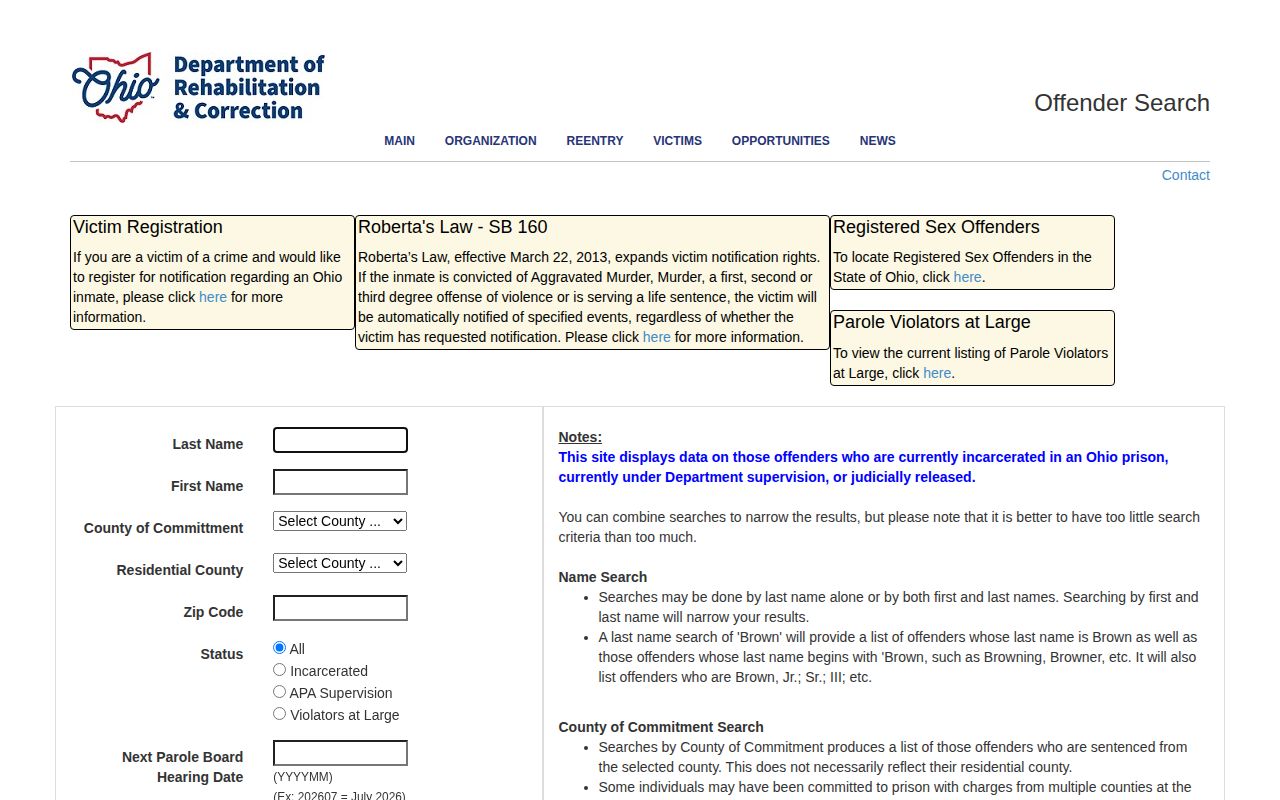
The image demonstrates the statewide search route, not a county-jail archive. Open a matching result and compare identifiers, offense, docket, sentence, status, and release detail before drawing a conclusion.
Note: County of Commitment identifies the sentencing source, while Residential County works only with certain APA status filters.
Ottawa County Recent Release Records
The Sheriff does not publish a separately identified official 24-hour or 72-hour release feed, a guaranteed update cadence, or a public-screen retention period. The official JailTracker portal is useful for present local visibility. Its absence of a person is not a historical result. For a defined time window, ask for existing jail-register entries whose discharge dates fall between two exact timestamps rather than asking the Sheriff to create a custom list.
Ohio VINE can report release or transfer events while a custody record is active. The Sheriff app’s current Google Play listing describes public inmate views, but no reviewed source establishes a released-person tab or rolling release list. The Ottawa County 24-hour release process explains the same-day fallback without inventing a feed.
Ottawa County Release Supervision Paths
Post-release status can sit in one of three systems. ODRC Adult Parole Authority covers parole, post-release control, judicial-release supervision, and violators at large. Common Pleas Adult Probation and Municipal Court Probation supervise local court cases. The Ohio Parole Board makes parole decisions for eligible sentences, but a favorable future date is not confirmation that the person physically left prison.
Use the ODRC APA Office field for state supervision. Use the sentencing docket and correct court probation office for local probation. A pretrial-monitoring participant has left jail but has not completed the case. A work-release participant remains in custody even during approved work hours. Those distinctions are covered in the Ottawa County post-release supervision records.
Ottawa Release Alerts and Transfers
Ohio VINE through VINELink can provide county-jail and ODRC custody events by telephone, email, SMS, or TTY when offered. Select the record for the right facility. A county-jail transfer and an ODRC release are different events. For telephone alerts, the registrant creates a four-digit PIN and enters it followed by # during the automated call. Ohio warns that VINE should not be the only verification source.
Federal custody needs its own chain. The BOP locator principally covers federal inmates released after 1982 and updates daily. A past release date or RELEASED location establishes departure from BOP, not the end of supervision or another hold. ICE’s locator can include people released from ICE custody within the prior 60 days. USMS has no general public person locator. No official evidence reviewed establishes an Ottawa County ICE detention contract, so immigration paths belong only in cases with a documented hold or transfer.
Note: Leaving federal custody can still lead to supervision or transfer, so read the location and receiving-agency details.
Ottawa Release and Custody Sources
No single portal covers every Ottawa County released inmate. Choose the source based on the custodian and the question being answered.
| Source | Best use | Important limit |
|---|---|---|
| Ottawa JailTracker | Current local jail visibility | Absence does not prove community release |
| Sheriff jail register | Date and manner of local discharge | Request may be needed |
| Local court dockets | Bond, sentence, dismissal, transfer, final disposition | May not show the physical exit time |
| ODRC offender detail | State custody, release, and APA supervision | Not a jail-only record |
| VINE | Custody-event alert | Notification data requires official confirmation |
| BOP or ICE | Federal or recent immigration custody | Not a general Ottawa County search |
Ottawa County Release Facilities
The Sheriff operates two distinct jails with 89 described beds in total. The Ottawa County Detention Facility is a 41-bed full-service jail for adult men and women charged with or convicted of misdemeanor or felony offenses. Community discharge is documented through the Sheriff, while transport to ODRC or another authority must be followed in the receiving system.
The Ottawa County Minimum Security Jail is a 48-bed dormitory-style facility. Jail staff make the final placement decision even when a court states that minimum security may be available. Movement between these two Ottawa facilities is an internal transfer. For either jail, the discharge register, court docket, and VINE event form the core verification chain.
Historical context shows why a current roster cannot answer every release question. The Sheriff’s 2018 annual report recorded 1,220 combined bookings and 1,211 releases across both facilities. Those are historical events, not current volume or unique-person counts, and they do not create a present release feed.